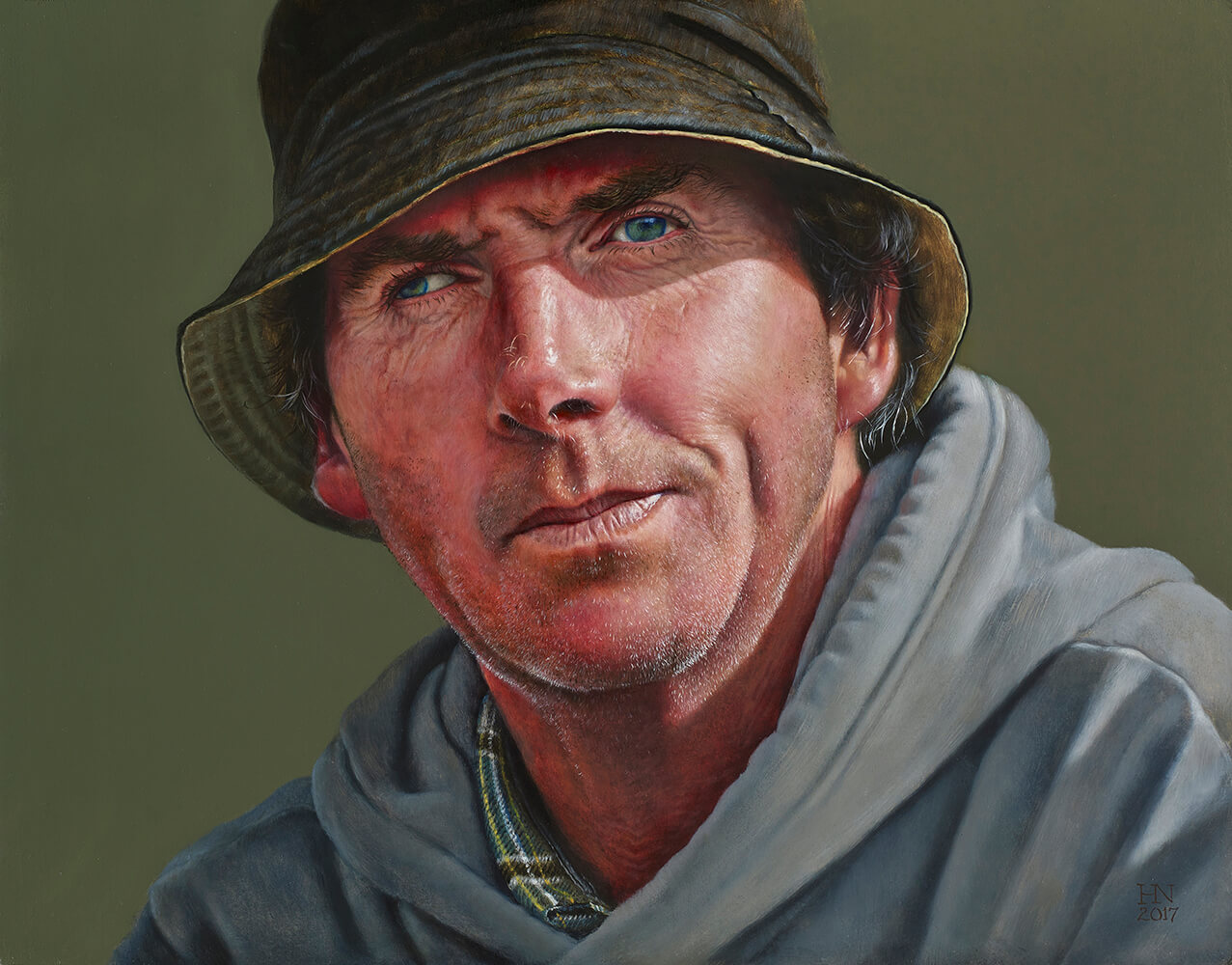
Tomas of Inisoirr
2017
18" X 14"
Oil on Panel
SOLD
Notes from my blog post…17 June 2017…and a bit extra
Ah, yer ever so kind…
such a warm and hearty response for Macy,
and I’m humbled, for my sins, by that.
This then, is Tomas.
He who lets Macy take the lead
as they welcome travelers to their tiniest of the Aran Islands.
This week, the annual Bodhran festival is taking place there.
On my bucket list, it is.
When they throw open the barn doors,
I’m certain Tomas and Macy
can hear all those drums a’ beating.
Brilliant.
On a side note, I googled Sir Tomas and discovered a lovely write up in the London Review of Books, Vol.33, No.12—16 June 2011, by Andrew O’Hagan about his travels with the Irish poet Seamus Heaney and editor Karl Miller. It seems the three of them went to the island of Inisoirr as a detour on a long trip through the British Isles. This is an excerpt…which perfectly describes Tomas, and his , “powerful sense of knowing his world”.
“The boat to Inisheer was busy but the water was very still. I took photos of Seamus and Karl as we crossed, and noticed how transfixed they were by the water and the distance from us to the land. As we left the boat at Inisheer I could hear people whispering Seamus’s name, and he is very good with that, saying hello to people. We climbed into a pony and trap at the pier and were soon off round the island. The man driving the vehicle was the very picture of robust outdoor health, and Seamus took pleasure, he said, in the way the fellow ‘lazily whipped’ the pony every few seconds. It was Seamus who seemed best able to speak to the man, negotiating the price in Gaelic – ‘driving a bard bargain’, as Karl suggested. As we trotted along the road – passing great, drystane dykes on every side, made of limestone – the man told us his name was Tomas Griffin. He said many on the island were O’Flahertys (‘the ferocious O’Flahertys’) or O’Briens, who had been routed by the former many years before. There were also a fair number of Kenneallys. Griffin gave off a powerful sense of knowing his world: having it by heart, every person and their history, knowing every corner of the island and how it might have changed over the years. Every inch of Inisheer seemed to be accounted for, marked off with stones. I’d have said he was a drinker by the weathered look of his face, if I hadn’t been more persuaded that his face was just an outdoor face, the complexion nature intended. He went on with his lazy whipping and near the top of a hill, as the sea appeared calm for miles, he looked again at Seamus. ‘You’re the famous poet,’ he said. He told us in the 1970s the only electricity on the island was provided by generators at the lighthouse, so they had the only TV and more than a hundred people crowded in there one time to watch the All-Ireland Final. He looked again at Seamus with a combination of shyness and intrigue. He clearly thought the poet was a country man who had somehow made it into the universe of electricity and television. “