By the time I started this painting I was deep into the zone.
I had found the essence of the story I wanted to tell with this series
and was deeply committed to telling it honestly.
I had learned how the light could change the color of the walls in every room.
How the quality of that same light could alter the temperature of the shadows.
Yet I was still finding little surprises along the way.
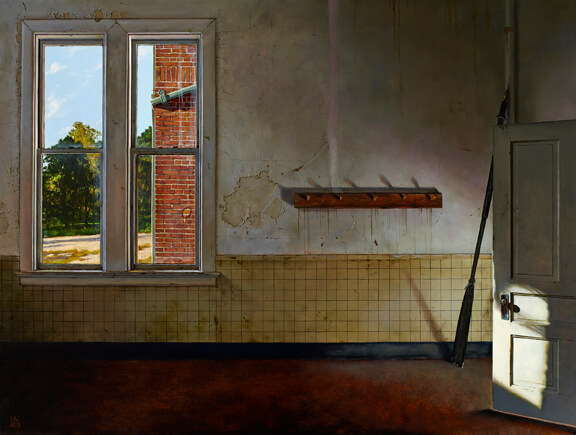
Like how, in this room, on this October morning,
that light could tease itself in an obscure angle
in front of and behind the open door
and cast a theatrical raking light right back up the wall.
I wanted to play with that so I added the oar.
It lives here in my studio but the painting needed some middle ground
and so did the story being told.
It is meant to represent the Sailing Camp Days
and the now empty former hospital rooms
had few traces of happily playing children.
But the rainbows
filtering in at the edges
seem to echo their voices.
So too, would that oar return to play a roll in the final painting in this series,
but you’ll have to wait a bit longer for that reveal…
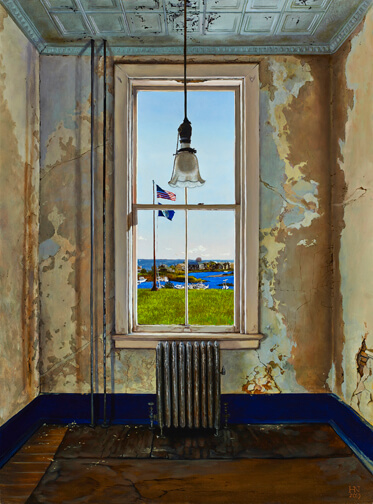
So, this is where it started to get real
I worked for several days
laying down layers of loose color
I knew it was the detail
the incredibly rich detail
of the stuccoed wall that was in play here
and it was great fun to build up the earthy colors
almost as if I had plastered it myself
and replastered
and repaired that replastering
but at some point
I think it was after I danced those dark lines of tin
underneath the peeling blue paint on the ceiling
I made the leap of faith
and committed to take those cracks
to a whole other level
and, as I mentioned in the catalogue,
that’s when I began to listen
on a much deeper level
to the stories the building
had to tell.
The view of those beautiful bricks framed by the tall pair of windows made me feel as if I was looking into a corner of some 18th century European city. Transported in that way, the warm earthy colors needed to become prominent and saturated to play off the contrasting cool blues in the tiles and the sink.
For most of the time it took me to paint this I was listening to The Magus, by John Fowles. Talk about contrasts. I was 18 when I took a course on that book in college. My friend Rex had insisted since it was being taught by his favorite professor, the poet William Meredith. A whole semester dwelling deep in the psychic depths of Fowles was intense to say the least and rereading it in my mid-fifties was a wild trip down that memory lane.
What shocked me the most was how incredibly naïve I was at the time of the first reading. Learned interpretive teachings aside, I couldn’t have had a clue what was really going on in that story. Not that I pretend to understand it much better now, but the decades and layers of life lessons in between made it feel like I have grown a heavy rain sodden wool coat of flesh over that tender young college student.
The patina on the outer surfaces of this building is like that coat.
Hard traveled…and well earned.
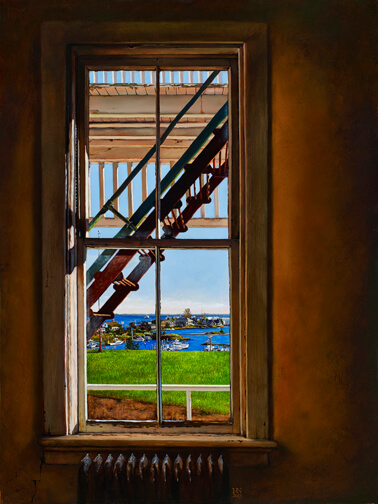
I am in love with these fire escapes.
They were originally painted red and green…
or maybe that’s wrong,
maybe the red is from the rusting over the years.
Either way they sport those colors now
and, when the morning light rakes across the lagoon,
they just sing against the whitewashed clapboard outside.
This was my first attempt at painting the buildings
and boats in the harbor and I got very familiar
with my magnifying glass.
It was a challenge to decide how much distortion
to render from the old rippling window glass.
I left just a little in because I wanted to see
the lines on the rigging and the deck on the ferry.
This is also the only view of the harbor
where I left the telephone poles in.
Artistic license is my super power.
This was the second painting I worked on in the series
and the first where I had just the architecture to focus on.
Every single surface was reflecting the sunlight differently.
I really had to learn the founding structure of the building
and came to appreciate my limited knowledge of construction
as I studied the sketches and reference photos
in great detail to make sure I got them accurate.
Once I had the bones down
it was all about the light.
And letting it dance around on the walls
and reflect off of the banisters
and drive that shaft straight into the foreground
and bounce back
in that impossibly blue line
just behind the door.
So now you know what the series Reclamation is all about. I’ll fill in with some of the backstory for each of the 10 paintings…
Marine Castaway – 25″ x 28″
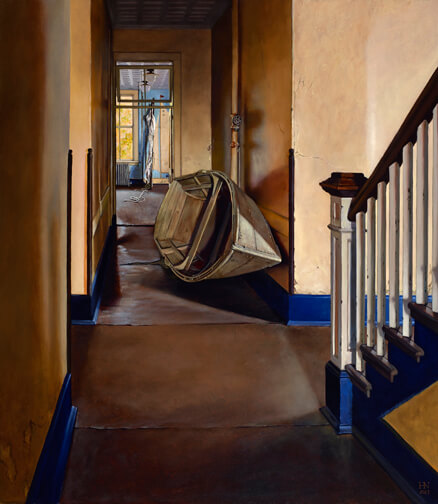
When I walked into this hallway and saw that old boat my heart skipped a beat.
It was not just the surprise of seeing it “out of water” as it were, but the juxtaposition of it against the primitive mural in the room beyond.
There was a long period of incubation in between my autumn visits to the building and finally picking up a paint brush to begin this series. As I mentioned in the catalogue, it wasn’t even a series at first. But the image of this boat, the intrigue and the challenge of how to render its character, was what I kept being excited by, so it became the jumping off point.
This, for me, more that any of the other paintings in this series, captures the broad arc of the story of this building’s history. From Marine Hospital, to Children’s Sailing Camp…and now the opening chapters of it’s future as the home of the Martha’s Vineyard Museum.
Now we take a big detour in which we find ourselves on the opposite end of the island of Martha’s Vineyard. Nestled in the little town of Vineyard Haven is a hidden treasure and rendering its essence became my winter’s studio work…
Reclamation – 24″ x 48″
Reclamation – An exploration of a hidden island treasure
Hidden vistas, historic vineyard homesteads, echoes of vintage islanders, the tools of their trades and the marks they have left in the wake of their time here are meaningful touchstones for the muses and vivid fodder for the creative soul. So it was, that when I sat down at my studio table a few months ago and read in the Vineyard Gazette about the Martha’s Vineyard Museum acquiring the old Marine Hospital building in Vineyard Haven, I was eager to see it for myself.
The Marine Hospital was built in 1895 and sits on a prominent hill overlooking what had only a few years earlier, in 1871, assumed its modern name of Vineyard Haven. Over the last hundred plus years it had become obscured by the substantial growth of oaks, maples and at least one Siberian Elm whose towering beauty still envelopes one entire wing. I’m probably not the only visitor, when hailing the island from the upper deck of the ferry, to be surprised by its stalwart presence on the horizon, after the museum returned the landscaping to its earlier state. While the clearing reveals an old friend on the town’s skyline, it also restores the dramatic view from atop that hill looking out over the expanse of lagoon and harbor and Vineyard Sound.
My curiosity was satisfied when Denys Wortman, MV Museum Board member whose Vineyard roots are deeply woven into the fabric of the island, graciously guided me on a tour of the building last October. He filled me in on the history of the building which was a 30 bed state of the art hospital treating islanders, soldiers in both World Wars I and II, and sailors who passed through the busy port. It boasted the island’s first x-ray machine and elevator in a brick addition which was built in 1938. Walking through its cavernous hallways we peered around the blackened walls of the darkroom where those x-rays were developed and explored the operating room and its alcoves.
The hospital was de-commissioned in the early 1950’s and the St. Pierre family took over its care and ran a summer camp there up until 2006. You can see echoes of those happy campers in the murals of sailboats painted on the wall in one of the bright corner rooms. The building is infused with light by virtue of the many tall windows and the glassed transoms over the doorways which let that light cascade deeply into the space. When I remarked on the graceful woodwork and the way each of the stuccoed corners was wrapped in a slender finial-capped turning of mahogany, Denny said there is someone on the island who has some extra pieces of those in a barn as his father was one of the craftsmen who worked on the building.
It’s that kind of lore which excites me and makes this building special. From the half-tiled walls to the pressed tin ceilings, the patched and re-patched plastered surfaces and the ornately decorated cast iron radiators, the juxtaposed textures of weathered brick and smoothly polished patina of creamy porcelain, to the greening of the old copper and the deep marine blue painted baseboards that anchor the vaulted spaces to solid ground… the architecture is elegant in its simplicity and charms the esthetic heart.
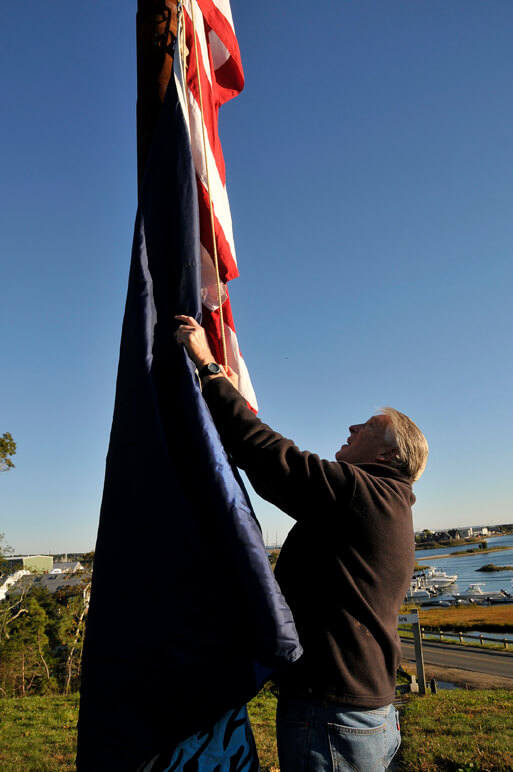
I returned to the building many times during that autumn visit and tried to experience how the light and shadows changed over the course of a day. One morning Denny met me and brought along the museum flag. When I stepped outside to walk across the wide expanse of front lawn to help him raise it I commented on how there wasn’t a cloud in the crisp October sky. “Pilots call that Severe Clear”, he replied.
Back in my Pennsylvania studio when I was looking through the sketches and notes I had taken I found that I had written down that phrase and, for almost every morning of the dozens of days it took me to paint this view from the balcony, the spring sky here was brilliantly cloudless…so the title fits.
I didn’t start out to make this a series, but as I finished each painting and saw them leaning along the studio walls it became clear that together they were beginning to tell a deeper story. One which the building itself had to tell. I wasn’t there to be a witness to the bustle of its early hospital days, or the loneliness of the few years that it sat vacant, or the second incarnation as children’s voices filled the hallways, but the spirits of those who moved through the corridors during its lifetime were present and as I studied and listened I was beginning to see the first inklings of its next chapter.
The museum had begun to move some of its acquisitions into the future home, and I found a particularly symbolic beauty in the dear old row boat that was resting against the standpipe in the downstairs hallway. Through the open door behind it you could just catch a hint of the mural depicting the “Sweet 16″ Menemsha wooden sailboat. A real life version of which is tarped over and grounded on blocks outside and just around the corner. Though a fair enough challenge to capture the building and the boat faithfully in all their weathered-chip-painted glory… I had a blast painting them both.
And I learned something about myself as an artist over the months of producing this collection of paintings. With each one I dug a little deeper into the surfaces, took more time to study the textures and stepped further out on that edge of rendering. I went from seeing the rooms first as vessels of color and light and then slowly, as details came into sharper focus, a sort of map would appear. A map of stories. Those finely chiseled cracks in its well used surfaces were asking to be painted honestly and I had to find the courage to listen and to work harder at seeing the building…and myself.
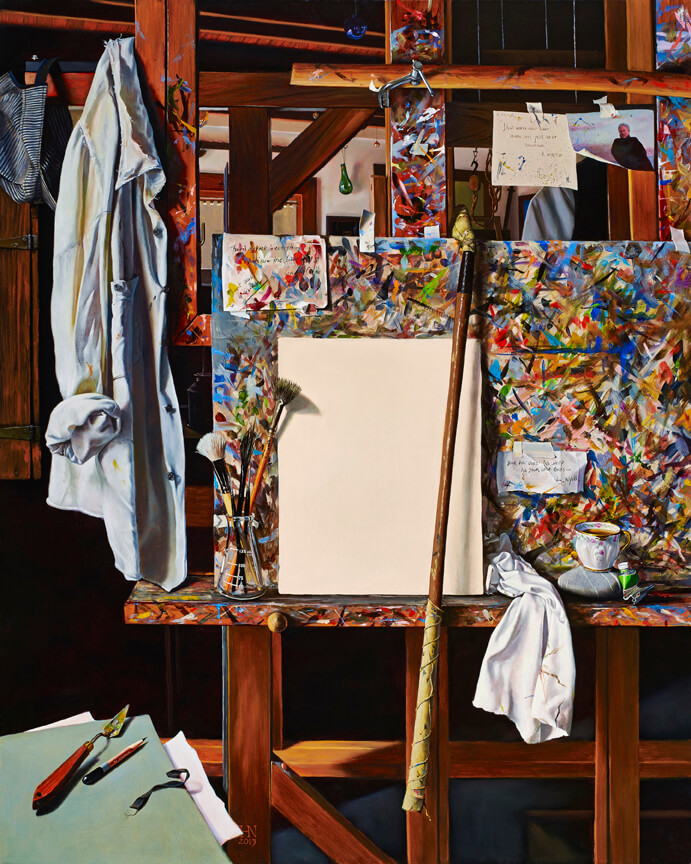
This painting began with the title, a line from the wonderful Leonard Cohen song, Anthem whose chorus goes like this…
Ring the bells that still can ring Forget your perfect offering There is a crack in everything That’s how the light gets in.
And it was taped to my easel for over a year. Now, everything on, or pretty much near, my easel eventually becomes a wiping surface for my brushes. After that much time the tattered notation was almost completely obscured by paint. But still, it and all the other quotations that surround me there are doing their job.
They are there to nudge, and in some cases to shove, my fears and doubts and ego and shaky confidence all aside. There are notes of encouragement, interesting thoughts that I lifted from the books I listen to while working, reminders when to plant garlic, and, like this one, words or phrases that I thought would be good painting titles that need time to percolate.
In addition to the notes, I have a support system of talismans. Objects that are touchstones to people and memories that have had profound influences on my creative journey. The ones featured in this painting include the well worn denim shirt, on the back of which is embroidered the cartoon character of Ziggy hand sewn for me by my very first patron, Stephanie, whose never wavering support began in our high school days.
And there is the also well worn railroad hat from my beloved Pops, Fred Decker. There’s a great photo of him wearing that hat, which is taped to the shelf behind my easel chair, wherein he is sitting next to my grandmother Mima, on the sofa in Craley, being mischievous together before they became leaders in my pack of guardian angels .
The old niblick, wooden golf putter, has been re-serviced as my mahl stick, holding up my favorite teacup is the beach stone which was handed to me by Mr. Morse and which echoes the deep connection to those Vineyard shores… and, most importantly, looking down from above is the photograph of Herself taken on the bluff in Chilmark where our hearts were joined.
The window to the left provides the light that I need to see the panels, but the true light, the authentic self which I am constantly seeking, shine back at me from these precious objects.
Today we leave the Chilmark store and continue up island…past the long lines of devoted fans waiting in line at Chilmark Chocolates, down the hill and over the little bridge that was washed away by Great Hurricane of 1938, slow down when you reach the Quitsa Pound, and just after the dog leg you hang a left onto Greenhouse Lane.
Now this is not a public road, just a sandy old chisled up vineyard kind of a lane that has been used gently for centuries. For the last three decades it has led me to the closest thing I have ever known to home. Camp Sunrise, in all it’s humble glory, sits on the edge of the bluff overlooking the dramatic vista of the Atlantic Ocean. And sadly, that sentence is soon to become past tense.
Much of the island’s south shore has been devoured by the recent series of intense storms leaving unprecedented erosion. A handful of vintage buildings which, for the last few years now, have been tenuously clinging to the craggy edge of the planet…are losing their grip.
So the beloved old chicken coop of a cottage must be torn down. I can hardly bear to write that sentence. So many years of magnificent memories there. A new house has been designed for the meadow behind the marsh and it promises to retain the “character” of the old place. I will get over myself and summon up excitement to see it.
And I have a few more compositions from the old place which I haven’t yet painted, and which need to be painted to tell its story. And now, there will be new chapters as well as new vistas…
It seems fitting then, that this painting got finished this year…
The Caretaker – 18″ x 24″
It has come to pass.
For the second time in my lifetime,
the bluff on which this tiny house sits
has been carved away by the elements.
The spirits have reclaimed the sands
and stopped just short of its fragile wooden front porch.
It was easier to take the first time.
We were younger
and there were more of us
to remember how the pieces fit back together.
Now its time for the next generation to take care.
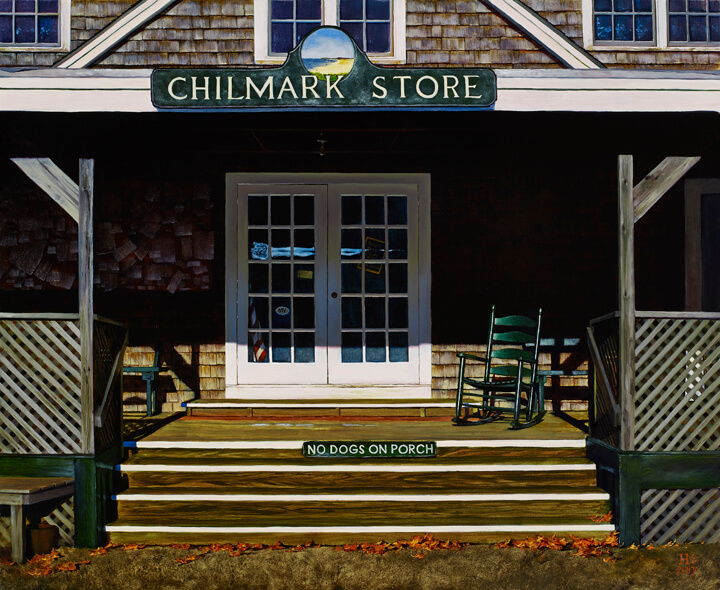
Well, it is now…but way back at the end of October, when I first started working on this painting, the Chilmark Store Porch was a ghost town.
So we have left the seaworthy sights and sounds of Menemsha and retraced our steps to Beetlebung Corner. But this time we are turning right. Slowly, slowly, just a few short feet more…and there it is. If you time it right, one of the 4-runners will be backing out just in time for you to pull in. But if you don’t, just wait a couple seconds more for the next satisfied customer will be exiting shortly.
Closed for the Season – 16″ x 19″
There is so much nostalgia weathered into the boards of this old porch.
Generations of up island travelers have stopped to set a spell in the heavy green rockers. Early on a summer morning the smell of roasting coffee mingles with the fresh ink on the Gazette.
The lazy mornings give way to the serious trekkers dipping in for their subs and refilling their water bottles.
Afternoons, the kids gather and scatter and gather again and if rain is in the offing it can be standing room only until the skies clear and the bikes can roll out again.
And then it’s time for pizza ! With Frank’s home grown veggies the pies are legendary.
Back before they decided that hydroperoxide and baking soda was the best remedy for skunk attacks I remember making it just in time to be the last customer to buy all the tomato juice cans on the shelf.
Oh, the gratitude, for the all the pleasures of an up island convenience store with friendly faces and wonderful short order cooks and a welcoming porch…full of rocking chairs.