I just figured out #24 across. The clue… Beachfront house asset. 4 letters.
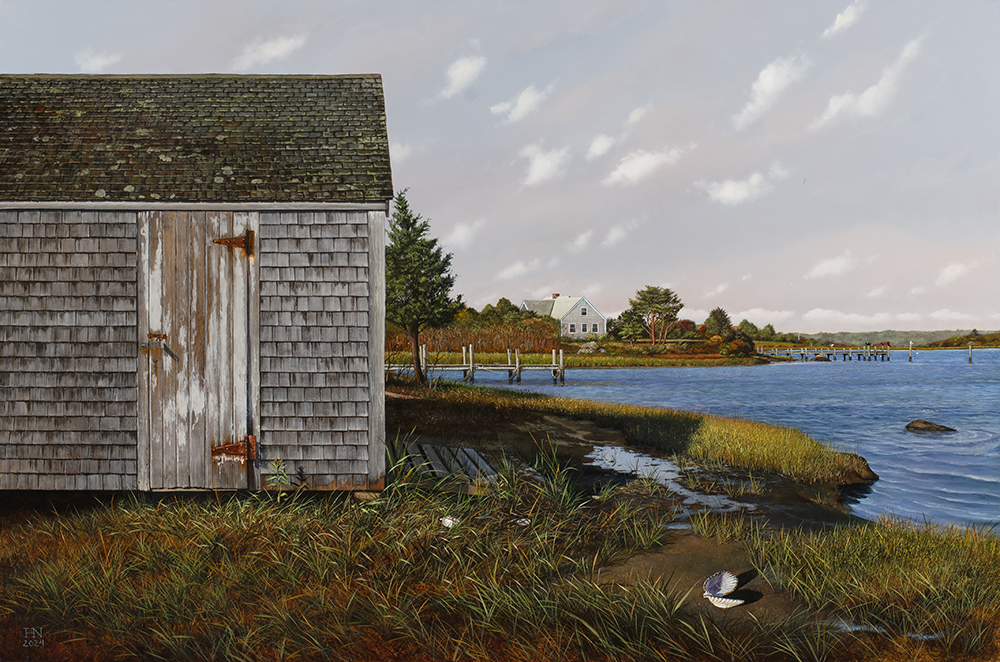
The answer is this painting.
So if you were to stand inside of the painting Stone Shadows and walked through the stone all and up that grassy slope keep going along the left side of the house and turn to your left.
This is your view.
Which is also the answer.
To every difficult puzzle you have ever had to solve.
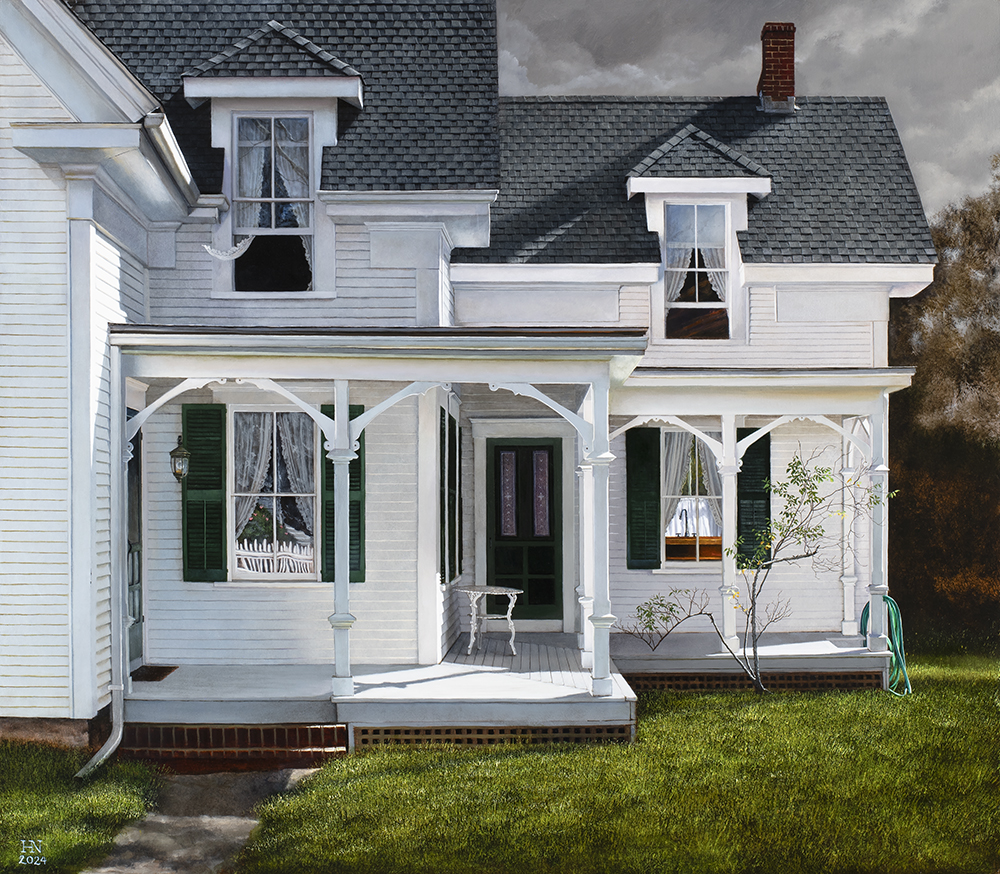
My pal Ted… On many of our drives around the island as we passed through the little hamlet of West Tisbury Ted would retell the story of two white houses sitting side by side mirroring each other’s front porches and clapboarded wings.
You know about those houses right ? They were built by two sisters who wanted to live separately but keep an eye on each other so they built them so the kitchen windows were just across the way.
I really enjoyed that while painting all that white washed wood I never actually dipped into the white paint.
And that when I started searching online for a place to stay while visiting for this summer show I did a double take to see this front porch from a slightly different angle listed as available to rent.
No coincidence, I expect…Ted… that we’ll be getting to choose for our ownselves which of those windows to open soon.
PS – upon reflection and looking more closely at google earth there are two other houses on that side of the street which would fit the brief of side by side kitchen windows…so if I got the house mixed up please don’t tell Ted.
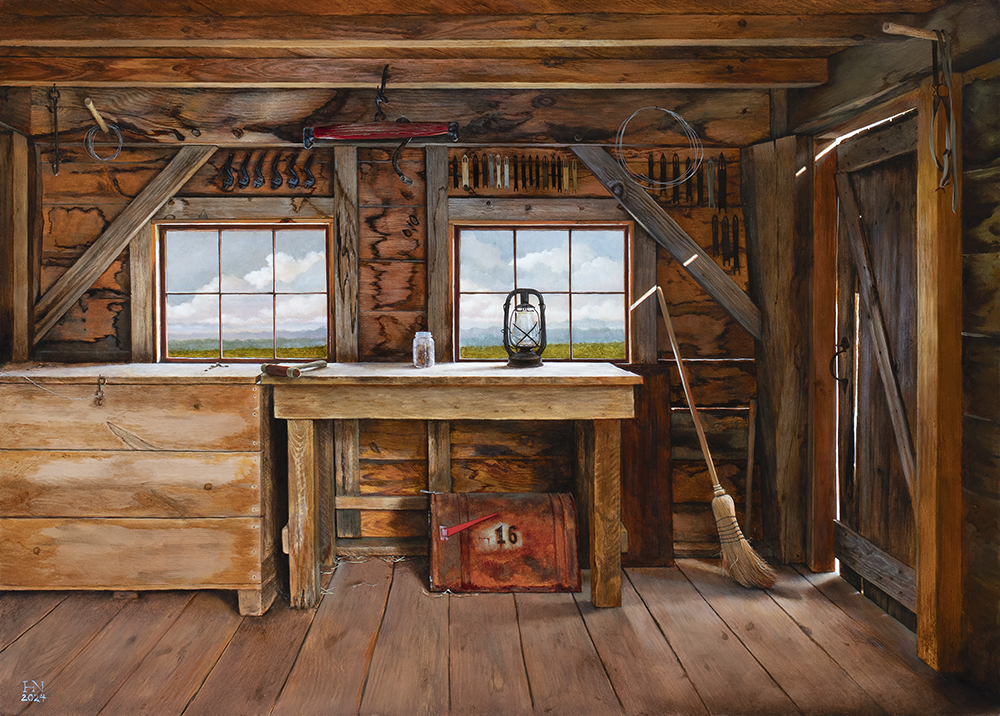
That dear man had mad mad organizing skills. I have never ever seen anything as satisfying as the order which he brought to his vast collection of tools.
It was sublime.
There was another room the opposite wing on this beautiful barn which at one time had every square inch covered in minutely crafted rows upon rows of multiple variations hanging together like a symphony written on dusty brown wooden walls one note at a time.
I stumbled on this shop at the Mystic Seaport Museum for the first time last year. It was October and early in the day and for some reason it was empty of people and full of tiny treasures.
Half my life ago I was a woodworker. My shop was in the basement of a log cabin. There was an annex of sorts, the back porch, which was covered. I kept the shaving horse and chopping stump out there for whittling the green wood down from log to chair parts. Sitting on that bench I had a private water view and families of wild creatures along the creek who shared their songs and dances and whispered dreams with me.
My father worked with wood. It was a hobby he did alone and also in basements. Growing up we moved a dozen times and I remember a long cardboard box held together by wide brown Allied moving van tape in which he carefully stored a wooden ship model kit. The Cuttysark.
It was off limits to his four wee children but once or twice I got to see him with an xacto knife trimming tiny parts and a tweezer pulling black thread through the blocks until he completed it and built a display case and brought it up to the dining room.
And I remember well the excitement, curiosity and wonder in his eyes when we visited Mystic for the first time. When I pause like this to think about it there are quite a few loves that we shared.
Maybe he is smiling somewhere reading this and seeing that I have my own long cardboard box and xacto knife with wee wooden bits of the Cuttysark waiting for me on the library shelf.
When a boat comes back home to the mother ship the command is given to “Rest Oars”.
This boat lives aboard the sailing ship the Charles W. Morgan in the Mystic Seaport Museum and according to their site it is the oldest commercial ship still afloat. The Morgan was built in 1841 and used to hunt whales for oil and baleen. It is a magnificent vessel and the museum has done an outstanding job of restoring her.
As with all the buildings and ships at the museum, they are preserved to tell our history and keep the stories alive.
The story of the whaling industry is deeply woven into maritime history and the telling of that story is as brutal as it is adventurous. No one told it better than Melville and my copy of Moby Dick was the first book I read in my new studio library.
The US chapter of that saga was ended when those oars were given the command to rest in 1971. The Morgan’s whaling days ended well before that in 1921. When we know better we do better.
What I love most about this little whale boat is that every time I visit the museum someone is nearby or often sitting in it telling how and why it was used.
In its simple design and complicated patina it is a touchstone to the generations of sailors who went down to the sea in ships.
And then Maggie and I took a walk. Through the seaport village of Mystic, along the harbor’s edge, and out back to the shipyard.
A truly dog friendly museum with water bowls and benches and grassy greens in between the historic buildings… and ships. Vessels of all manner and size and in every degree of completeness and restoration.
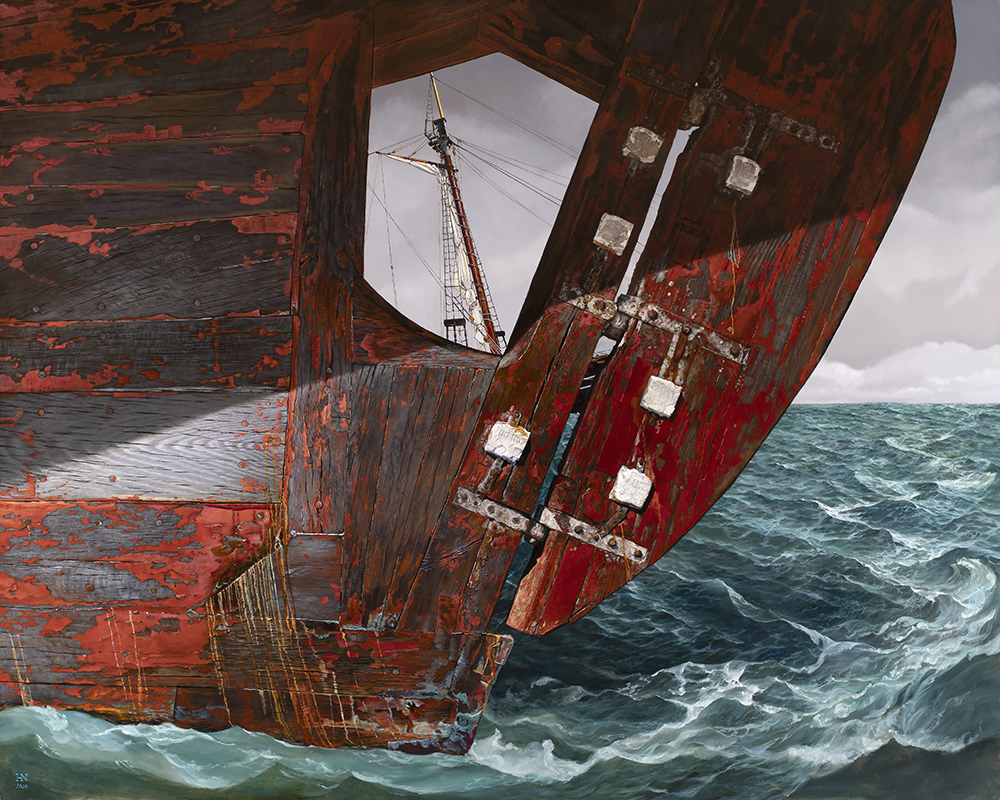
As we rounded the harbor into the working shipyard we ran into the behemoth of a hull of the L.A.Dunton. Drydocked for a major restoration, the commercial fishing schooner which was built in Essex, MA in 1921, was awaiting the ship carpenters to do what they do best…preserving ships and their history so the stories can be seen and told a hundred years from now.
Out of the water she stood at least two stories tall. Stem to stern is 104 feet of massive wooden planking. As we walked around the rear of the ship the sun… there goes that wonderful sunlight again… was raking over the hull. The top half was deeply in shadow the beneath the slanting line the rust and paint work was alive with color.
The blazing red and the electric golds. Walking up close I noticed those ceramic squares attached to different areas of the surface. Worn almost to the point of disappearing, I could still read the words…
Do Not Paint Well consider me challenged Muses…you’re on !
My first art teacher Jim Gainor used to tell us… Paint the air not the chair. That giant negative space created by the opening where the propeller is housed presented the perfect frame in which to paint the masts of the Amistad as I saw them just around the corner that day.
PS- The Docent at Mystic seemed to think that the plaques were meant to warn shipwrights because the type of paint used would corrode the surface of the metal fastenings. I observed that over the years this warning was overlooked.
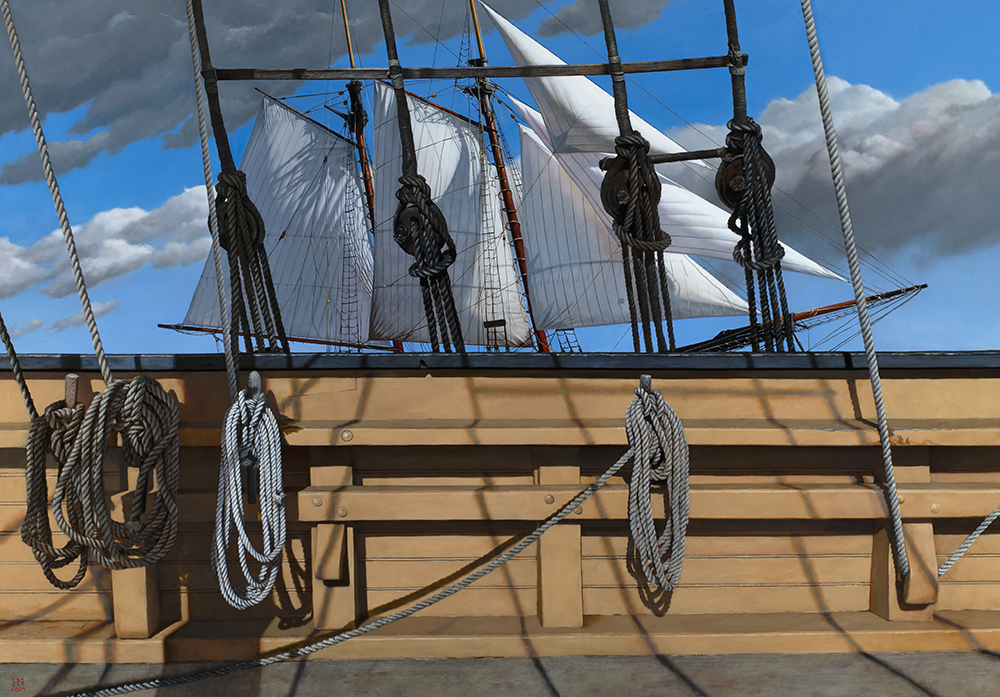
It began when the sun broke through. Standing on the deck of the Charles W. Morgan, in the seaport village of Mystic, on a cloudy October morning, I was studying the pattern of ropes and getting lost in the tarry darkness of her shrouds. When suddenly the gun metal gray sky split apart and sunlight filled the ship. Through the rigging, and across to the other side of the dock, it sent a brilliant shaft that lit up the towering masts of the Amistad*.
The sunlight washed over now glowing wooden surfaces, highlighting and warming the white of the sails as they spilled over the lines and ropes which gathered them loosely to the iron rings.
I was once again moved by the power of the Muses who so often shove me into “seeing” something deeper in what was right before my eyes.
But the story didn’t end there, bathed in all that revelatory sunlight.
When I got home to the studio and began to study both my sketches and reference shots I did some research into the history of the Amistad, the one at Mystic being a reproduction of the original slave transport vessel, and found my way to a stunning photograph of the ship sailing fully rigged and sailing on the water. Talk about the sun breaking through…
After much soul searching I did something I have never done. I contacted the photographer to humbly ask permission to use her image as a reference. Within minutes I heard back from Caryn B. Davis with a gracious response and nod of ok. The afternoon I spent wiggling down the rabbit hole learning about her and the stunning images she captures of gardens, landscape architecture, and from her travel adventures and perusing her articles and books on her website was magical. Treat yourselves with a look.*
Permission in hand, the composition now took on a completely different narrative. The Amistad I had first seen in Mystic was docked for repairs and maintenance. Beautiful in her bare bones, the rigging and mast details were telling one story. One in which the patina of weather and sailor’s toil was alive.
Then I got a glimpse of her glory through Caryn’s lens.
The Amistad, sails alive with sunlight and billowing with ocean breezes, brought the exuberance of adventure on the high seas bursting through the doors, into the studio, and before me on the easel.
The high seas.
A place where my head had been living in earnest for most of the winter. At sea and onboard ships. Massive old wooden sailing vessels. And one ship in particular.
I have signed on to a fascinating citizen scientist project and now spend the early hours of my days up in my studio loft reading and editing the log book for the US Jamestown. Focusing on her voyages starting just before the outbreak of the Civil War in June of 1861. Every corner of my world is now brimming with books of reference for all things maritime and US history from that era. From the now well thumbed copy of The Sailor’s Word Book to books about how to rig a ship, tie all manner of knots, the history of the US Navy, genealogy of the Civil War Era and how to make sense of some very flowery handwriting and grammar written 200 years ago.
There is a huge and ongoing learning curve for me embarking on this log editing voyage. It is challenging and thrilling on every level. Every time I get to transcribe the words…”BEAT TO QUARTERS !!!” I scream them out like Captain Jack Aubrey. I have spent over 260 swashbuckling hours at the easel listening to the entire Aubrey/Maturin Series written by Patrick O’Brian.
Making vivid every sensation and detail of life aboard those sailing ships, Master and Commander was my Master Class and helped to illustrate many of the “obscure to me” terms and words I have been trying to interpret from the Jamestown log book. I know where an Iron Norman goes, what the punishment is for dropping a marlin spike from aloft, and I can Holystone a deck in any fathom.
This full on emersion has permeated every corner of my world. Along with the new reference books, the shelves of the library are filling up with old ink wells and pens, bits of rope that I’ve used for knot tying practice, and boxes of wooden ship models are there waiting to be tackled. And it has filtered down through the Muses and into the subjects… and objects…in many of this year’s paintings.
The synesthesia of ocean, islands in the ocean, history, maritime and otherwise, the images the muses bounce around inside my brain, the images I see outside my studio windows and the studio itself have all merged into the arching narrative of the Granary Gallery 2024 Show…
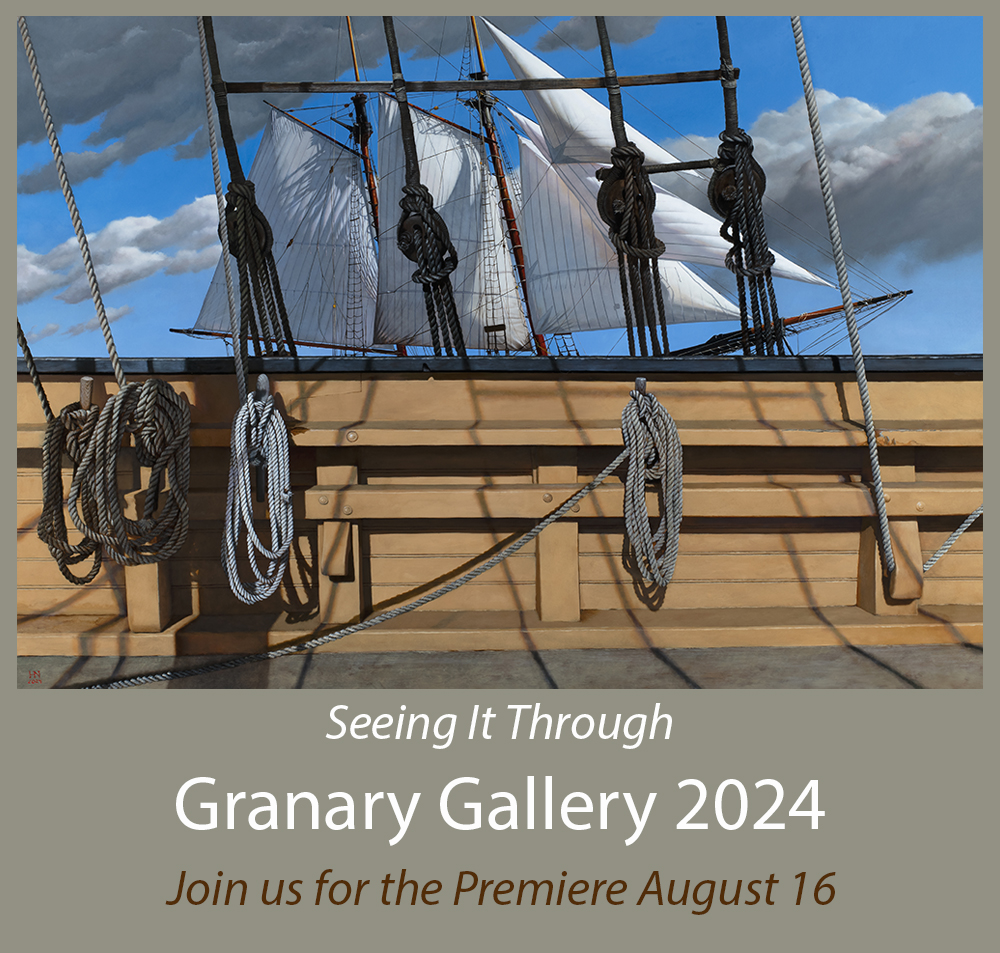
Seeing It Through.
Notes and Links
*Caryn B. Davis Photography
carynbdavis.com
*From the Mystic Seaport Website and Discovering Amistad:
mysticseaport.org
discoveringamistad.org
“In 1839, Mende captives from Sierra Leone took control of the ship transporting them to slavery, the Amistad. Unable to navigate back to Africa, the ship was captured and towed into the port of New London in Connecticut. The Mende were faced with slavery or execution, and their cause was taken up by many residents throughout Connecticut. U.S. Circuit and District courts ruled in favor of the Mende. This case was then appealed to the U.S. Supreme Court and in 1841 this court agreed with the lower court decisions and the Mende captives were ordered freed. The vessel on display is a reproduction of that ship. It was built at the Mystic Seaport Museum Shipyard and launched in 2000.
The Amistad is an iconic representation of the fight for justice and freedom in the United States and beyond. Discovering Amistad is a non-profit educational organization that provides year-round programming, inviting children and adults to discover the story of the Amistad and its impact on Connecticut and the nation through the present day. The 128-foot replica of the schooner and the lessons of the Uprising aboard it in 1839 provide the foundation to explore the concepts of freedom, power, justice and equality.
Since its establishment in 2015, Discovering Amistad has welcomed thousands of visitors aboard the ship to provide insights into Connecticut and the nation’s history through the lens of a floating classroom.
In addition to a classroom curriculum, in recent months, the organization has expanded its programming to offer online learning, dockside education and leadership training, and magnified its partnerships to address injustice, promote diversity and facilitate conversations about the role we all must play in dismantling systemic racism.
As the nation continues to wrestle with the painful realities of racism and oppression in our society, the lessons of the Amistad, and the fulfillment of Discovering Amistad’s mission have never been more relevant.”
And since my last blog entry was over 8 months ago, I’d say it’s time to re-enter the sphere of social communication and see how everyone is doing out there.
It’s a sizzling summer and by now, most of you who are under the massive dome of excessive heat have at least one new way to keep cool. You gardeners out there are definitely getting creative with watering techniques. The/We Boomers amongst us have finally given in to comfortable orthopedic shoes and jar openers. The great grandbabies of we boomers are proudly parading in their Pride onesies. And our canine companions are slowly beating their tails to a different drummer just to keep their cool vibes going.
Here in the studio things are also heating up.
The annual Granary Gallery Show date is visible on the calendar and we are getting excited. For the first time since the pandemic shifted all our worlds Herself and myself….and Maggie will be attending the show opening in person !
None of this virtual phoning in nonsense. We are looking forward to seeing all of you and reminding you just how much your support, friendship and patronage means to us.
The Muses threw a curveball right around spring training time and gave me a theme to work with for this year’s show.
Seeing It Through
I’ve had some months now to work with this creative challenge and am going to see if I can convey the journey in the Painter’s Notes. Keep an eye out for them in the coming weeks.
The annual rollout of new paintings will happen early this year so stay tuned for that as well.