When a boat comes back home to the mother ship the command is given to “Rest Oars”.
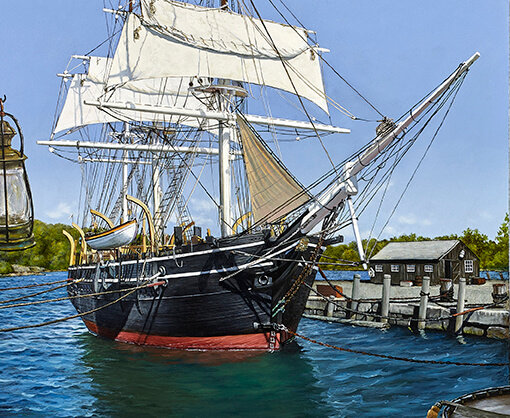
This boat lives aboard the sailing ship the Charles W. Morgan in the Mystic Seaport Museum and according to their site it is the oldest commercial ship still afloat. The Morgan was built in 1841 and used to hunt whales for oil and baleen. It is a magnificent vessel and the museum has done an outstanding job of restoring her.
As with all the buildings and ships at the museum, they are preserved to tell our history and keep the stories alive.
The story of the whaling industry is deeply woven into maritime history and the telling of that story is as brutal as it is adventurous. No one told it better than Melville and my copy of Moby Dick was the first book I read in my new studio library.
The US chapter of that saga was ended when those oars were given the command to rest in 1971. The Morgan’s whaling days ended well before that in 1921. When we know better we do better.
What I love most about this little whale boat is that every time I visit the museum someone is nearby or often sitting in it telling how and why it was used.
In its simple design and complicated patina it is a touchstone to the generations of sailors who went down to the sea in ships.
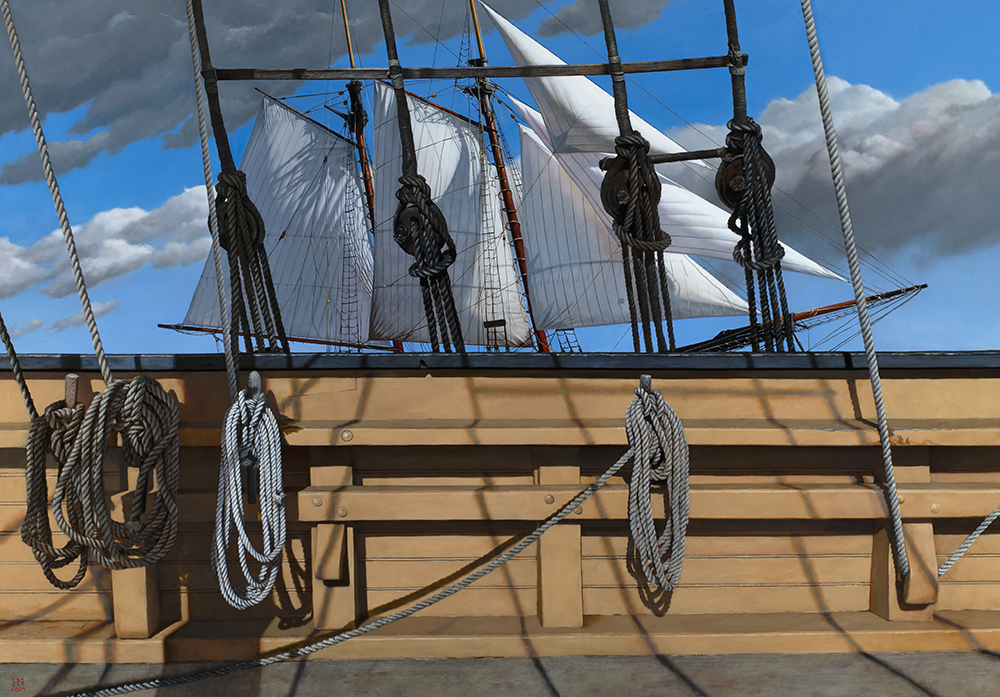
It began when the sun broke through. Standing on the deck of the Charles W. Morgan, in the seaport village of Mystic, on a cloudy October morning, I was studying the pattern of ropes and getting lost in the tarry darkness of her shrouds. When suddenly the gun metal gray sky split apart and sunlight filled the ship. Through the rigging, and across to the other side of the dock, it sent a brilliant shaft that lit up the towering masts of the Amistad*.
The sunlight washed over now glowing wooden surfaces, highlighting and warming the white of the sails as they spilled over the lines and ropes which gathered them loosely to the iron rings.
I was once again moved by the power of the Muses who so often shove me into “seeing” something deeper in what was right before my eyes.
But the story didn’t end there, bathed in all that revelatory sunlight.
When I got home to the studio and began to study both my sketches and reference shots I did some research into the history of the Amistad, the one at Mystic being a reproduction of the original slave transport vessel, and found my way to a stunning photograph of the ship sailing fully rigged and sailing on the water. Talk about the sun breaking through…
After much soul searching I did something I have never done. I contacted the photographer to humbly ask permission to use her image as a reference. Within minutes I heard back from Caryn B. Davis with a gracious response and nod of ok. The afternoon I spent wiggling down the rabbit hole learning about her and the stunning images she captures of gardens, landscape architecture, and from her travel adventures and perusing her articles and books on her website was magical. Treat yourselves with a look.*
Permission in hand, the composition now took on a completely different narrative. The Amistad I had first seen in Mystic was docked for repairs and maintenance. Beautiful in her bare bones, the rigging and mast details were telling one story. One in which the patina of weather and sailor’s toil was alive.
Then I got a glimpse of her glory through Caryn’s lens.
The Amistad, sails alive with sunlight and billowing with ocean breezes, brought the exuberance of adventure on the high seas bursting through the doors, into the studio, and before me on the easel.
The high seas.
A place where my head had been living in earnest for most of the winter. At sea and onboard ships. Massive old wooden sailing vessels. And one ship in particular.
I have signed on to a fascinating citizen scientist project and now spend the early hours of my days up in my studio loft reading and editing the log book for the US Jamestown. Focusing on her voyages starting just before the outbreak of the Civil War in June of 1861. Every corner of my world is now brimming with books of reference for all things maritime and US history from that era. From the now well thumbed copy of The Sailor’s Word Book to books about how to rig a ship, tie all manner of knots, the history of the US Navy, genealogy of the Civil War Era and how to make sense of some very flowery handwriting and grammar written 200 years ago.
There is a huge and ongoing learning curve for me embarking on this log editing voyage. It is challenging and thrilling on every level. Every time I get to transcribe the words…”BEAT TO QUARTERS !!!” I scream them out like Captain Jack Aubrey. I have spent over 260 swashbuckling hours at the easel listening to the entire Aubrey/Maturin Series written by Patrick O’Brian.
Making vivid every sensation and detail of life aboard those sailing ships, Master and Commander was my Master Class and helped to illustrate many of the “obscure to me” terms and words I have been trying to interpret from the Jamestown log book. I know where an Iron Norman goes, what the punishment is for dropping a marlin spike from aloft, and I can Holystone a deck in any fathom.
This full on emersion has permeated every corner of my world. Along with the new reference books, the shelves of the library are filling up with old ink wells and pens, bits of rope that I’ve used for knot tying practice, and boxes of wooden ship models are there waiting to be tackled. And it has filtered down through the Muses and into the subjects… and objects…in many of this year’s paintings.
The synesthesia of ocean, islands in the ocean, history, maritime and otherwise, the images the muses bounce around inside my brain, the images I see outside my studio windows and the studio itself have all merged into the arching narrative of the Granary Gallery 2024 Show…
Seeing It Through.
Notes and Links
*Caryn B. Davis Photography
carynbdavis.com
*From the Mystic Seaport Website and Discovering Amistad:
mysticseaport.org
discoveringamistad.org
“In 1839, Mende captives from Sierra Leone took control of the ship transporting them to slavery, the Amistad. Unable to navigate back to Africa, the ship was captured and towed into the port of New London in Connecticut. The Mende were faced with slavery or execution, and their cause was taken up by many residents throughout Connecticut. U.S. Circuit and District courts ruled in favor of the Mende. This case was then appealed to the U.S. Supreme Court and in 1841 this court agreed with the lower court decisions and the Mende captives were ordered freed. The vessel on display is a reproduction of that ship. It was built at the Mystic Seaport Museum Shipyard and launched in 2000.
The Amistad is an iconic representation of the fight for justice and freedom in the United States and beyond. Discovering Amistad is a non-profit educational organization that provides year-round programming, inviting children and adults to discover the story of the Amistad and its impact on Connecticut and the nation through the present day. The 128-foot replica of the schooner and the lessons of the Uprising aboard it in 1839 provide the foundation to explore the concepts of freedom, power, justice and equality.
Since its establishment in 2015, Discovering Amistad has welcomed thousands of visitors aboard the ship to provide insights into Connecticut and the nation’s history through the lens of a floating classroom.
In addition to a classroom curriculum, in recent months, the organization has expanded its programming to offer online learning, dockside education and leadership training, and magnified its partnerships to address injustice, promote diversity and facilitate conversations about the role we all must play in dismantling systemic racism.
As the nation continues to wrestle with the painful realities of racism and oppression in our society, the lessons of the Amistad, and the fulfillment of Discovering Amistad’s mission have never been more relevant.”
Remember that spinning loft ?
All those woven fibers.
This painting started out to be about the boat.
Behind that cross of knotted rope
is the hull of a whaleboat
suspended from the rigging
along the side of the Charles W. Morgan
come to rest in the harbor
of the Mystic Seaport Museum.
The muses wanted to tell
a different story.
Distill the elements
down to the three..
The rope
the boat
and the sea.
I found a Yankee Magazine video…
of the historic modern day voyage
that the MS Museum made possible in 2015.
Like a freshening breeze,
it takes us onboard the ship
for an upclose look at what it takes
to get her under sail.
And what I saw…
Rope.
Thousands of yards
of Rope.
HUZZAH !
to all who invested
time and treasure
to bring this magnificent
vessel back to life.
We have climbed the gangplank and boarded the Charles W. Morgan.
Towards the bow of the vessel, just to the right of the great steering mechanism at the helm, there is a narrow winding passage of stairs leading down below the main deck and into the Captain’s quarters. On the right is a room that slants into the bow of the ship, with an elegant sweep of a settee with room enough for a Windsor chair and a small writing desk. Step down and through a doorway to the left and you enter this chamber.
The private sleeping quarters for the captain…a separate cheerie little chamber having been built for at least one of the captain’s wives up on the main deck where she could be relieved of her claustrophobia and seasickness.
The Mystic Seaport Museum has a sign hanging on the other side of that louvered door on the left …
See at the very end there, where it describes the “gimbaled bed”.
That was a fun thing to paint. It looks funny without legs, and I kept wanting to make it level but that’s how it rolls.
What drew me to spend a few weeks inside this chamber was the light. For a dark and close space, this room was filled with many sources of light bouncing within. I found it a happy place to be but I have seen Master and Commander, many many times, and I’m not sure I would have been cut out to sleep anywhere in that ship…
during a storm…
on the high seas.
I am pleased to invite you all to the island of Martha’s Vineyard for the opening of my 2018 show at the Granary Gallery.
Sunday August 5, from 5-7pm
I’ve been in a full tilt painting sprint since January and I laid the last of the brushes down only a few hours ago.
The work this year takes us to a few new places, has a few new faces, and takes some head long dives into depth and detail.
I’m as eager as I’ve ever been to launch the annual rollout of New Paintings. It will be the first chance I get to see them as an entire show. During the long months of production, the finished works are set aside to dry in stacks throughout the studio until it is time to begin varnishing and photographing. Due to space limitations here, this happens in stages and until I walk into the gallery on the afternoon of the show, the first glimpse I get of them all together is on this blog as I unveil them to you…dear viewers.
So let’s get right to it…
Let’s take a boat to Mystic…
The Cooper’s View – 24 x 28
There are a couple threads of themes which run through the 14 paintings for this year’s show. This painting weaves two of them together. Mystic and Me.
When I was a young girl living in Swarthmore, PA, our family would escape the dangers of Mischief Nights around Halloween and drive up to New England. I have vivid memories of exploring Mystic Seaport in Connecticut. My father loved boats and was building a wooden model of the Cuttysark around that time, and some of those interests filtered down to me…but I didn’t appreciate it back then.
What drew me in was the Cooperage. The Mystic Seaport Museum is a magical collection of all things maritime and wooden boat building and seafaring lore. A historic seaport village, along the banks of the Mystic River, brings maritime life in the 1800’s… alive.
From their website…“The buildings you see aren’t replications–they’re trade shops and businesses from the 1800s that were transported to Mystic Seaport from locations around New England. The village is made up of many bustling maritime trades, from shipsmiths and coopers to woodcarvers and riggers.”
So picture a 10 year old girl, whose three younger brothers are running off the energy from the long car ride, while she walks into the dark and dusty cave of the Cooperage.
( I have added a link here to the museum’s website where you can watch a nice little video and see inside the place for yourself.)
I was fascinated.
A small shack full of wooden barrels, and piles of wood shavings, and a shaving horse…
Fast forward about 20 years or so and look where that little girl was sitting…
I wielded my own drawknife for a decade making chairs and spoons and baskets and such. Then I put down the woodworking tools and picked up the brushes.
Fast forward another 20 years and that little girls has just turned 60.
And, on one of her now regular trips to New England, she returned to Mystic and once again stood inside the dark wooden den of the Cooperage…and turned around.
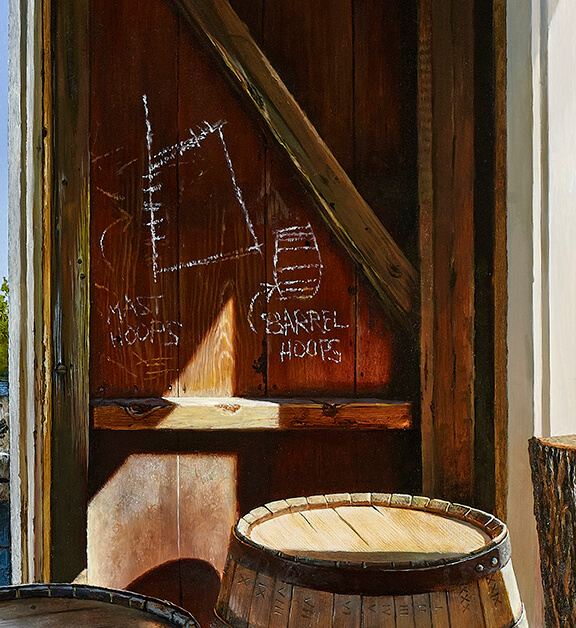
The Cooper’s View is just that. On this crisp fall day the sunlight bounces off of the t’gallant sails being raised on The Morgan which is docked just outside of the shop.
The Charles W. Morgan is the last of the American whaling fleet and was painstakingly restored at the Mystic Seaport Museum. (here’s a link to the museum’s website with a complete history and chronicle of her restoration…Click Here.)
We will go on board that ship in tomorrow’s blog post, but linger here a while and soak in the salty air and take a closer look at that rigging…
enjoy the playful pastel diagrams drawn inside…
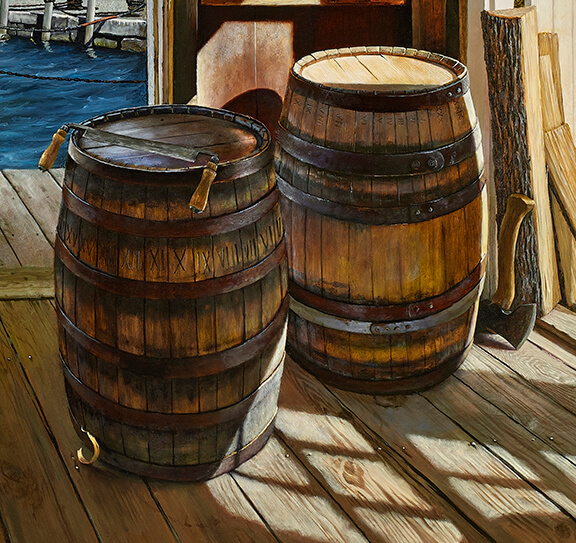
and study the roman numerals carved on the barrel stays…
The artiste has taken license, in an autobiographical way, and added her own hatchet and well worn drawknife to authenticate the pastiche.
It was deeply moving for my 60 year old self to stand in that shop again and realize that I’ve come full circle, and back around yet another one, to complete a creative cycle that my 10 year old self didn’t even know how to dream of.