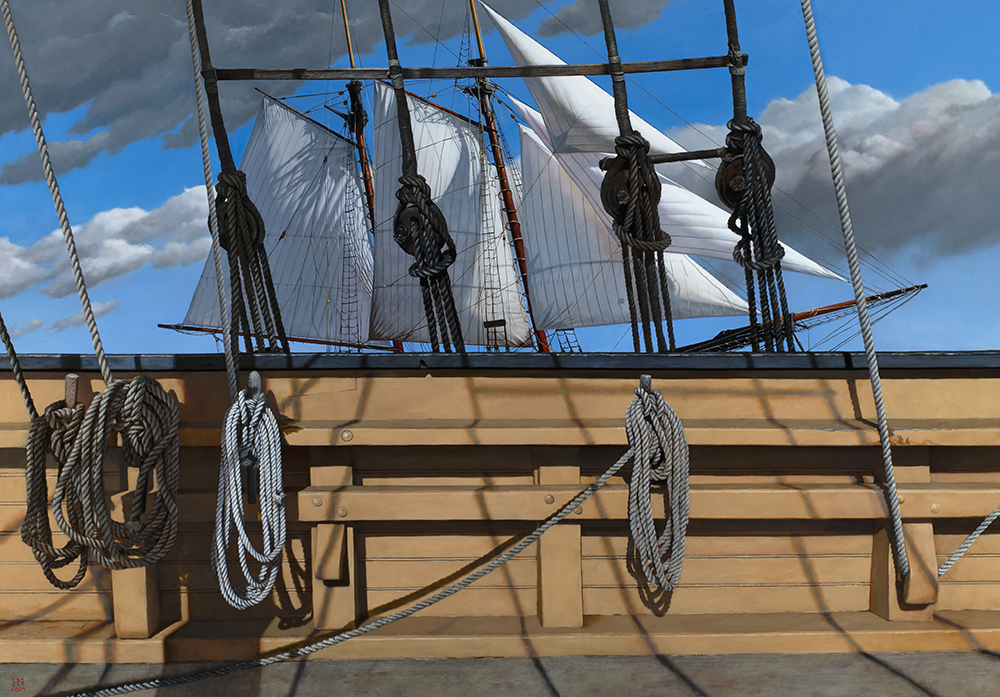
Seeing it through…the shrouds
It began when the sun broke through.
Standing on the deck of the Charles W. Morgan, in the seaport village of Mystic, on a cloudy October
morning, I was studying the pattern of ropes and getting lost in the tarry darkness of her shrouds.
When suddenly the gun metal gray sky split apart and sunlight filled the ship.
Through the rigging, and across to the other side of the dock,
it sent a brilliant shaft that lit up the towering masts of the Amistad*.
The sunlight washed over now glowing wooden surfaces, highlighting and warming the white of the sails as they spilled over the lines and ropes which gathered them loosely to the iron rings.
I was once again moved by the power of the Muses who so often shove me into “seeing”
something deeper in what was right before my eyes.
But the story didn’t end there, bathed in all that revelatory sunlight.
When I got home to the studio and began to study both my sketches and reference shots I did some research into the history of the Amistad, the one at Mystic being a reproduction of the original slave transport vessel, and found my way to a stunning photograph of the ship sailing fully rigged and sailing on the water.
Talk about the sun breaking through…
After much soul searching I did something I have never done. I contacted the photographer to humbly ask permission to use her image as a reference. Within minutes I heard back from Caryn B. Davis with a gracious response and nod of ok. The afternoon I spent wiggling down the rabbit hole learning about her and the
stunning images she captures of gardens, landscape architecture, and from her travel adventures and perusing her articles and books on her website was magical. Treat yourselves with a look.*
Permission in hand, the composition now took on a completely different narrative. The Amistad I had first seen in Mystic was docked for repairs and maintenance. Beautiful in her bare bones, the rigging and mast details were telling one story. One in which the patina of weather and sailor’s toil was alive.
Then I got a glimpse of her glory through Caryn’s lens.
The Amistad, sails alive with sunlight and billowing with ocean breezes,
brought the exuberance of adventure on the high seas bursting through the doors,
into the studio, and before me on the easel.
The high seas.
A place where my head had been living in earnest for most of the winter. At sea and onboard ships.
Massive old wooden sailing vessels. And one ship in particular.
I have signed on to a fascinating citizen scientist project and now spend the early hours of my days up in my studio loft reading and editing the log book for the US Jamestown. Focusing on her voyages starting just
before the outbreak of the Civil War in June of 1861. Every corner of my world is now brimming with books of reference for all things maritime and US history from that era. From the now well thumbed copy of The Sailor’s Word Book to books about how to rig a ship, tie all manner of knots, the history of the US Navy,
genealogy of the Civil War Era and how to make sense of some very flowery handwriting and grammar written 200 years ago.
There is a huge and ongoing learning curve for me embarking on this log editing voyage. It is challenging and thrilling on every level. Every time I get to transcribe the words…”BEAT TO QUARTERS !!!” I scream them out like Captain Jack Aubrey. I have spent over 260 swashbuckling hours at the easel listening
to the entire Aubrey/Maturin Series written by Patrick O’Brian.
Making vivid every sensation and detail of life aboard those sailing ships, Master and Commander was my Master Class and helped to illustrate many of the “obscure to me” terms and words I have been trying to
interpret from the Jamestown log book. I know where an Iron Norman goes, what the punishment is for dropping a marlin spike from aloft, and I can Holystone a deck in any fathom.
This full on emersion has permeated every corner of my world.
Along with the new reference books, the shelves of the library are filling up with old ink wells and pens, bits of rope that I’ve used for knot tying practice, and boxes of wooden ship models are there waiting to be tackled. And it has filtered down through the Muses and into the subjects…
and objects…in many of this year’s paintings.
The synesthesia of ocean, islands in the ocean, history, maritime and otherwise,
the images the muses bounce around inside my brain, the images I see outside my studio windows
and the studio itself have all merged into the arching narrative of the Granary Gallery 2024 Show…
Seeing It Through.
Notes and Links
*Caryn B. Davis Photography
carynbdavis.com
*From the Mystic Seaport Website and Discovering Amistad:
mysticseaport.org
discoveringamistad.org
“In 1839, Mende captives from Sierra Leone took control of the ship transporting them to slavery, the Amistad. Unable to navigate back to Africa, the ship was captured and towed into the port of New London in Connecticut. The Mende were faced with slavery or execution, and their cause was taken up by many residents throughout Connecticut. U.S. Circuit and District courts ruled in favor of the Mende. This case was then appealed to the U.S. Supreme Court and in 1841 this court agreed with the lower court decisions and the Mende captives were ordered freed. The vessel on display is a reproduction of that ship. It was built at the Mystic Seaport Museum Shipyard and launched in 2000.
The Amistad is an iconic representation of the fight for justice and freedom in the United States and beyond. Discovering Amistad is a non-profit educational organization that provides year-round programming, inviting children and adults to discover the story of the Amistad and its impact on Connecticut and the nation through the present day. The 128-foot replica of the
schooner and the lessons of the Uprising aboard it in 1839 provide the foundation to explore the concepts of
freedom, power, justice and equality.
Since its establishment in 2015, Discovering Amistad has welcomed thousands of visitors aboard the ship to provide insights into Connecticut and the nation’s history through the lens of a floating classroom.
In addition to a classroom curriculum, in recent months, the organization has expanded its programming to offer online
learning, dockside education and leadership training, and magnified its partnerships to address injustice, promote diversity and facilitate conversations about the role we all must play in dismantling systemic racism.
As the nation continues to wrestle with the painful realities of racism and oppression in our society, the lessons of the Amistad, and the fulfillment of Discovering Amistad’s mission have never been more relevant.”